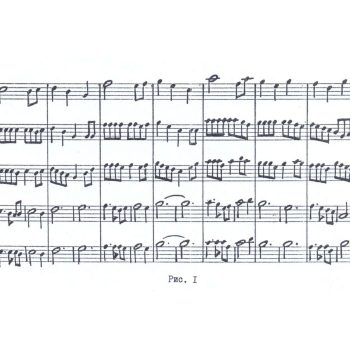
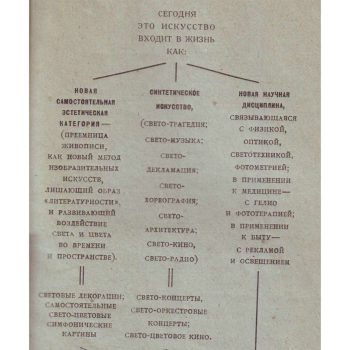
The application certificate for an “Electric musical device that would transform light impulses into musical sounds” was submitted by I. A. Sergeev on March 21, 1925 in Leningrad. Information about the issuance of the patent was published on January 31, 1930. A description of the device was given by A. Smirnov in the book “In Search of the Lost Sound”: “The patent describes a musical instrument equipped with a rotating disk with concentric rows of holes, which serves to convert light pulses into sound pulses according to a special optical score. The latter was a paper tape with transparent slits that let through modulated light corresponding to certain notes of the scale. It is interesting that the design of the instrument combines technical solutions used in two legendary devices at once – Evgeniy Murzin’s ANS synthesizer and Lev Theremin’s rhythmicon (the principle of an optical siren, 1931)” (Smirnov A. In Search of the Lost Sound, 2020, pp. 160). Close to the device of I. A. Sergeev in terms of the type of formation of the sound medium was the toolkit developed by N.V. Voinov (“drawn sound tracks”, “paper sound”) and E. A. Sholpo (“graphic sound”). In this kind of equipment, sound generators were created based on optical choppers. In this regard, we will take them beyond the scope of the presented classification, the basis of which is light and sound instruments, focused on demonstrating light and sound effects on the screen, stage, and in space.
Links to Third-Party Publications:
Sergeev I. A. Electric musical instrument: application. date No. 12625; application 03/21/1925; publ.: 01/31/1930 // USSR Patent Database. URL: https://patents.su/3-12625-ehlektricheskijj-muzykalnyjj-pribor.html; Smirnov A. In search of the lost sound. Experimental sound culture of Russia and the USSR in the first half of the twentieth century. M.: Garage Museum of Contemporary Art, 2020; Kolganova O. V. Classification of domestic light and sound instruments of the first third of the twentieth century (From chromotrope to kinemachrome) // The Art and Science of Television. 2025. No. 21.3. pp. 61–117. https://tv-science.online/

![f7f737191ea9669fdd942225327aae10[1]](https://archive.prometheuskzn.ru/wp-content/uploads/elementor/thumbs/f7f737191ea9669fdd942225327aae101-rk41yohq6rcxq8rzlbhj7fdvrzce2mjsux7w6vrg30.jpg "f7f737191ea9669fdd942225327aae10[1]")