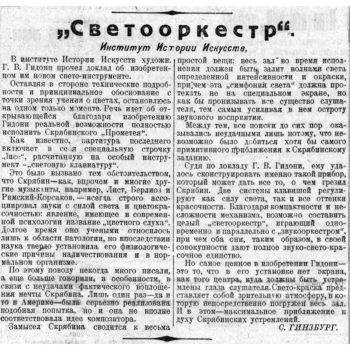
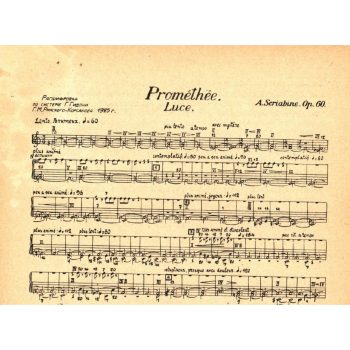
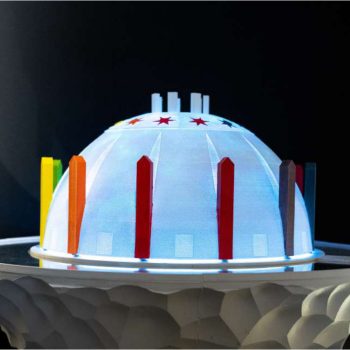
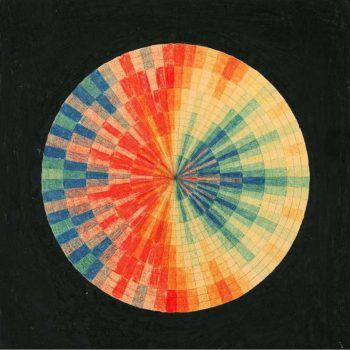
“In 1925, Kovalenkov,” note Zh.V. Knyazeva and A.A. Mikhailov, “proposed the creation of an instrument with two keyboards, each of which would control the sound and light range, respectively, and a system of pedals would regulate the intensity of the effect” (Knyazeva, Zh.V.; Mikhailov, A.A. Scientific collaboration between musicologist Ya.Ya. Gandshin and physicist V.I. Kovalenkova: creation of the Petrograd acoustic laboratory // Scientific and Technical Journal of the St. Petersburg State Polytechnic University 2011. No. 2). The same instrument was probably meant by G.M. Rimsky-Korsakov, when he published a decoding of the light line of Scriabin’s “Prometheus” according to G. Gidoni’s system and wrote about the need to construct an apparatus that “first of all gives a change in lighting, which, according to Scriabin’s plan, should fill the entire hall. The construction of such a device was promised by Prof. V.I. Kovalenkov, prof. A.L. Kupriyanov and engineer. G.K. Ustyugov (Leningrad Experimental Electrotechnical Laboratory, conducting the corresponding research together with the Department of Theory and History. Music. GIIII)” (Rimsky-Korsakov G. M. Decoding the light line of Scriabinsky’s “Prometheus” // De Musica: Temporary of the Department of Theory and History of Music of the GIIII. Leningrad, 1926. Issue 2).
Links to Third-Party Publications:
Knyazeva, Zh. V.; Mikhailov, A. A. Scientific cooperation between musicologist Ya. Ya. Gandshin and physicist V. I. Kovalenkov: creation of the Petrograd acoustic laboratory // Scientific and technical bulletins of the St. Petersburg State Polytechnic University. 2011. No. 2. p. 124–129; Kolganova O. V. Classification of domestic light and sound instruments of the first third of the twentieth century (From chromotrope to kinemachrome) // The Art and Science of Television. 2025. No. 21.3. pp. 61–117.
https://tv-science.online/wp-content/uploads/2025/12/TVstudies_21_3.pdf